Bicycle Safety
Passing distances, bicycle lanes, footpaths and intersections.
Key Areas You'll Cover
Overview
At a Glance: When you pass a bicycle rider in NSW, you must leave at least 1 metre where the speed limit is 60 km/h or less, and at least 1.5 metres where it’s over 60 km/h. To do this you may cross continuous dividing lines, but only with a clear view of oncoming traffic and when it’s safe.
Bicycle riders have the same right to use the road as drivers, but none of a car’s protection. The DKT tests the minimum passing distance, where riders may legally ride, and what drivers must do around them. These rules are newer than some others in the question bank, so they’re worth extra study.
Passing a Bicycle Rider
| Speed limit | Minimum passing gap |
|---|---|
| 60 km/h or less | 1 metre |
| More than 60 km/h | 1.5 metres |
The gap is set by the speed limit, not by how fast you happen to be going. Driving slowly doesn’t let you pass closer.
To give the required gap, you may, if necessary:
- drive to the right of the centre of the road;
- cross or straddle dividing lines, including single and double continuous lines;
- drive on flat painted islands and median strips.
You may do these only if you have a clear view of approaching traffic and it’s safe. Before a crest or blind bend you can’t see what’s coming, so wait behind the rider. You must never drive on a footpath or nature strip to get past.
Key Fact: The exception for crossing continuous lines covers bicycle riders, not slow cars, trucks or tractors. You can’t cross double continuous lines to overtake a motor vehicle.
If other drivers beep at you to hurry past a rider, stay calm and wait until you can pass safely with the full gap.
Sharing the Road
- Riders may ride two abreast, as long as they’re no more than 1.5 metres apart.
- Where there’s no bicycle lane, or using one isn’t practical, riders may use the full lane, often to avoid gravel or rough edges.
- Riders may use motorways and freeways unless a sign says they can’t.
- Never use your horn to intimidate a rider.
Dooring
You must not open a car door into the path of a bicycle rider. Before getting out:
- Check your mirrors.
- Look over your shoulder.
- Wait for any rider to pass.
Riders hit by an opening door can be seriously injured.
Bicycle Lanes, Paths and Footpaths
Bicycle Lanes
Where a bicycle lane is marked, riders must use it unless it’s not practical. Drivers may use a bicycle lane:
- to avoid an obstruction;
- for up to 50 metres to enter or leave the road;
- for up to 50 metres to overtake a vehicle turning right or making a U-turn;
- for up to 50 metres to enter a lane from the side of the road.
| Lane type | Distance drivers may use it for (entering/leaving etc.) |
|---|---|
| Bicycle lane | Up to 50 m |
| Tram lane | Up to 50 m |
| Bus, transit or truck lane | Up to 100 m |
Riders may also use bus lanes, transit lanes and truck lanes. They may not use bus-only lanes or tramways.
Footpaths
- Children under 16 may ride on the footpath, unless a “No bicycles” sign applies.
- Riders 16 and over generally may not, but there are exceptions. The main one is an adult supervising a child under 16 who is riding. Others include:
- postal workers on duty;
- riders carrying a child under 10;
- riders with a medical certificate.
When entering or leaving a driveway, give way to pedestrians and to riders on the footpath. Take extra care when reversing.
DKT Tip: The old footpath rule was “under 12”. It’s now under 16. Watch out for older study material.
Riders at Intersections and Traffic Lights
- Hook turns: riders may turn right using a hook turn unless a sign says they can’t. They wait at the far left, then cross when it’s safe or when the light turns green. They don’t need to give a hand signal for a hook turn.
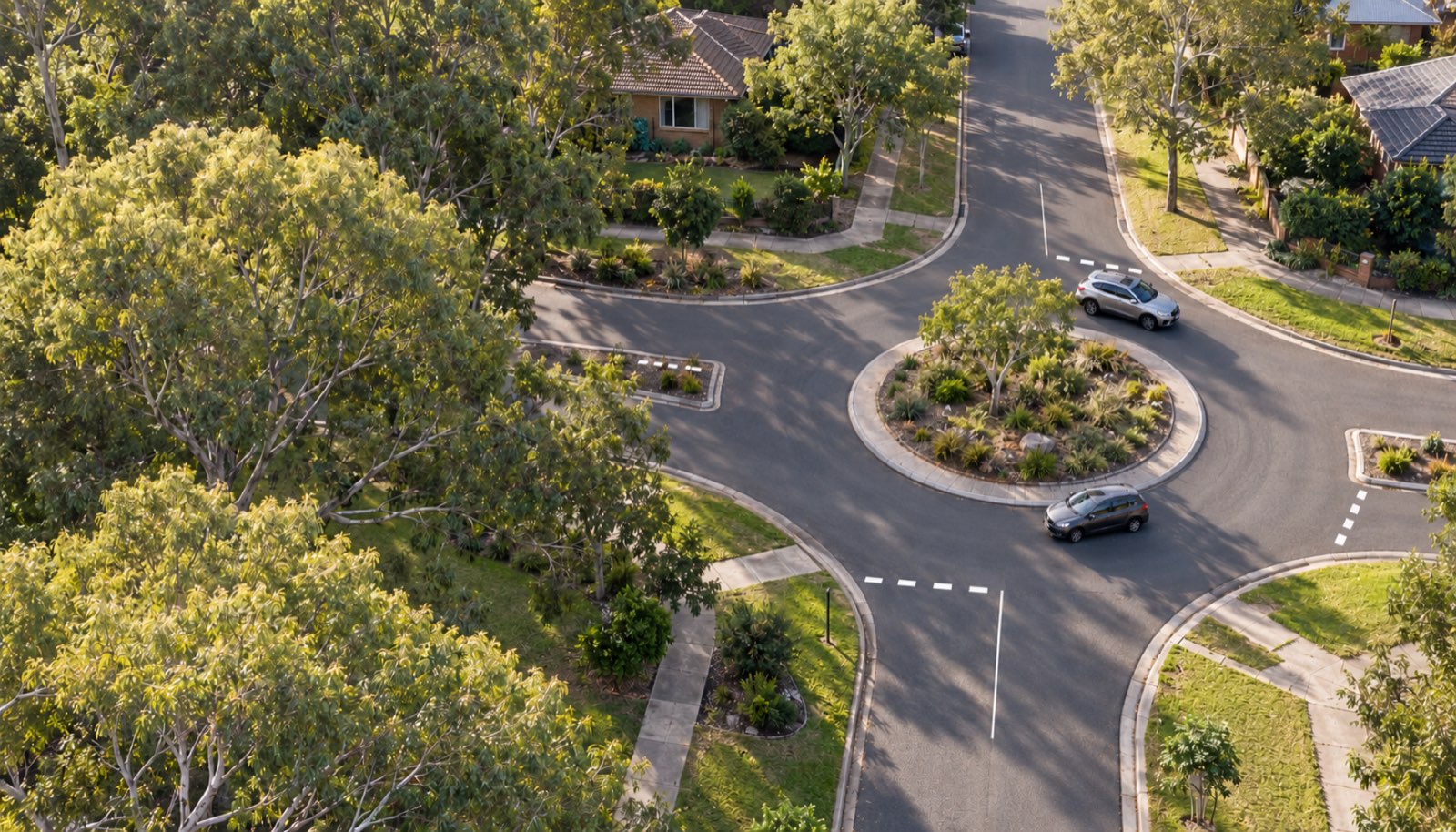
- Roundabouts: on a multi-lane roundabout, riders may turn right from the left lane, giving way to vehicles leaving the roundabout.
- Bicycle storage areas: the painted box at the front of a lane at traffic lights is for riders. Don’t enter or stop in it while the lights are red.
- Bicycle signals: a green bicycle light is for riders only. Drivers follow their own lights.
- Turning left: riders often travel at the far left and may pass on your left. Check your mirrors and blind spot, and let the rider go first instead of cutting across them.
Test yourself with the Bicycle Safety quiz.
Common Mistakes on the DKT
- Using your own speed to choose the gap. The speed limit decides: 1 m at 60 km/h or less, 1.5 m above that.
- Thinking you can never cross double lines. You can, to pass a rider safely.
- Thinking the line exception covers slow cars too. It doesn’t.
- Saying riders must ride in single file. Two abreast is legal within 1.5 m of each other.
- Using the old under-12 footpath rule.
- Using 100 m for bicycle lanes. It’s 50 m.
- Stopping in the bicycle box at a red light.
Ready to test your Bicycle Safety knowledge?
All 25 bicycle safety questions are in the app. Meanwhile, try the free mock DKT.
Get The Learners Test app
All 457 questions across 11 topics, full 45-question mock tests, flash cards and progress tracking.