Traffic Signs
Warning, regulatory, railway, roadwork and electronic signs.
Key Areas You'll Cover
Overview
At a Glance: NSW road signs fall into a few families. Regulatory signs are law and must be obeyed. Warning signs, usually yellow diamonds, alert you to hazards ahead. Roadworks and electronic signs control traffic at changing sites. Knowing the family a sign belongs to tells you most of what you need to know about it.
Traffic signs questions show you a picture and ask what it means or what you must do. In the official question bank, traffic signs have their own section, and in the in-person DKT they count towards the road safety part. Learn the categories first, then the individual signs.
Regulatory Signs
Regulatory signs tell you what you must or must not do, and breaking them is an offence. The handbook classes any sign showing when you must stop, give way, turn or enter as regulatory.
| Sign | Meaning |
|---|---|
| Speed limit (number in a red circle, white background) | Maximum speed. It’s not a target or a minimum |
| No entry | Don’t enter the road beyond the sign |
| No right turn (crossed-out arrow) | No right turn and no U-turn |
| No left turn | Don’t turn left |
| Arrow with “Only” | All traffic must go the way the arrow points |
| Right lane must turn right | If you’re in that lane, you must turn right |
| Keep left | Pass to the left of the sign (often on an island) |
| One way / Two way | Direction of traffic on the road ahead |
| Keep left unless overtaking | Use the right lane only to overtake or for another allowed reason |
Stop, Give Way and Roundabout Signs
- Stop: stop completely at the line every time, then give way.
- Give Way: slow down, be ready to stop and give way. You only stop if you need to.
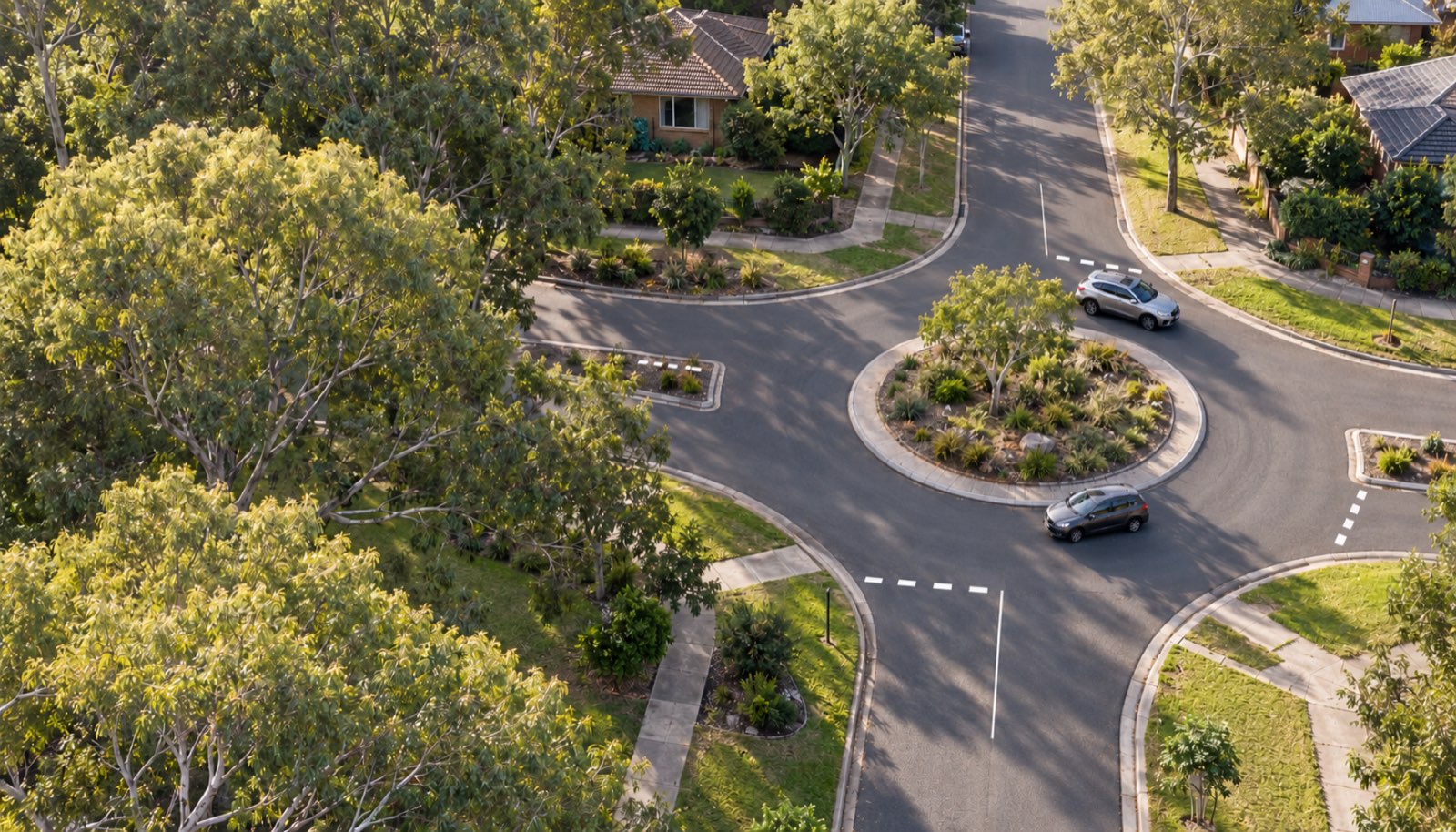
- Roundabout: give way to all vehicles already on the roundabout.
- Stop sign with three black dots: found at traffic lights. It applies only when the lights are off or flashing yellow.
- Yellow “Stop ahead” or “Give way ahead” signs: warnings that one of these signs is coming up.
Key Fact: A crossed-out right-turn arrow also bans U-turns. A U-turn starts like a right turn across the same traffic.
Warning Signs
The handbook describes warning signs as usually diamond-shaped, with black symbols or words on a yellow background. They don’t set a legal limit. They tell you to slow down and expect something.
Common warning signs fall into groups:
- Road layout: cross road, T-intersection, side road, sharp turn, winding road, road narrows, divided road begins or ends.
- Road surface and shape: slippery when wet, dip, hump, crest, steep descent.
- People and animals: pedestrians, children, bicycles, kangaroos, livestock.
- Other traffic: slow trucks entering, narrow bridge.
A distance plate under the sign, such as “next 30 km”, shows how far the hazard continues. A yellow advisory speed plate suggests a safe speed for a curve or crest in good conditions. It’s advice, not a legal limit.
A floodwater depth indicator shows how deep water is across the road. Even so, it’s safer to turn around or wait than to drive into floodwater.
DKT Tip: If a sign is yellow, think “warning, slow down”. If it’s white with red, or a Stop or Give Way shape, think “this is the law”.
Railway Crossing Signs
- Rail crossing warning: a level crossing is ahead. Slow down and look and listen.
- Flashing lights ahead: be ready to stop if the lights flash.
- Stop sign at a crossing: stop every time, even with no train in sight.
- Give Way sign at a crossing: slow down, look both ways, and stop if a train is coming.
- Flashing red lights: stop. Wait until they stop and any boom gates are fully up.
Roadworks and Electronic Signs
- Roadwork speed signs are regulatory and apply even when no workers are visible.
- A Traffic controller ahead sign means be ready to stop. A controller’s handheld Stop sign must be obeyed until they signal you on.
- School zone flashing lights mean the school zone limit is in force.
- Variable message signs show travel times and warn of crashes, fog or closures. They’re information, not a speed limit.
- Overhead lane signals:
- a red cross means the lane is closed;
- a white arrow pointing down-left or down-right means merge that way;
- a white arrow pointing up-left or up-right means exit, because the road ahead is closed.
Lane, Parking and Tram Signs
| Sign | Meaning |
|---|---|
| Clearway | No stopping during the times shown (only buses and taxis may pick up or drop off) |
| No stopping | Don’t stop at all, not even briefly |
| No parking | You may stop for up to 2 minutes to pick up or drop off, staying within 3 m of the car |
| T2 / T3 transit lane | Vehicles carrying at least 2 or 3 people, including the driver, during the signed times |
| Accessible parking | Only with a displayed Mobility Parking Scheme permit |
| Tram lane | Trams only. Others may use it for up to 50 m to enter or leave the road |
Read more in our NSW road signs guide, or go straight to the Traffic Signs quiz.
Common Mistakes on the DKT
- Treating a yellow advisory speed as the legal limit. It’s a recommendation.
- Forgetting that “No right turn” also bans U-turns.
- Mixing up No stopping and No parking. No parking allows a brief stop to pick up or drop off. No stopping doesn’t.
- Reading a warning sign as an instruction. The children sign, for example, warns you that children may be crossing. It doesn’t ban pedestrians.
- Ignoring roadwork limits when the site looks empty.
- Thinking a variable message sign sets a speed limit. Speed limits come from speed signs.
Ready to test your Traffic Signs knowledge?
All 59 traffic signs questions are in the app. Meanwhile, try the free mock DKT.
Get The Learners Test app
All 457 questions across 11 topics, full 45-question mock tests, flash cards and progress tracking.